
A goal of 1,800 kcal a day is easy to say; finding it in your weekly meals is another matter. Popotam works out your calorie needs and adjusts the amounts in your dishes, for free and with no account: you give your calorie goal (or work it out in four questions), and every lunch and dinner of your week aims for your target, with calories from the ANSES Ciqual table.
Popotam adjusts your weekly meals. Free, no account.
- Worked out in four questions
- Calories from the Ciqual table
- Your dishes, in the right amounts
Calories that make it all the way to your plate
Calorie calculators give you a number, then leave you alone in front of the fridge. Counting every meal by hand takes time, and a recipe found online is rarely written for your appetite: servings are “for four”, and that's it.
Popotam does both: it works out your target if you don't have one, then adjusts the amounts in every dish of your week to keep it, lunch and dinner. Your dishes stay the ones you love.
Set your goal in five steps
1. Open “Your plate”
In the app, open My preferences and go to the “Your plate” step (it's the same step when you create a meal plan). Two ways to go: “Simple: by appetite” or “Precise: in calories”.
2. Give your calorie goal
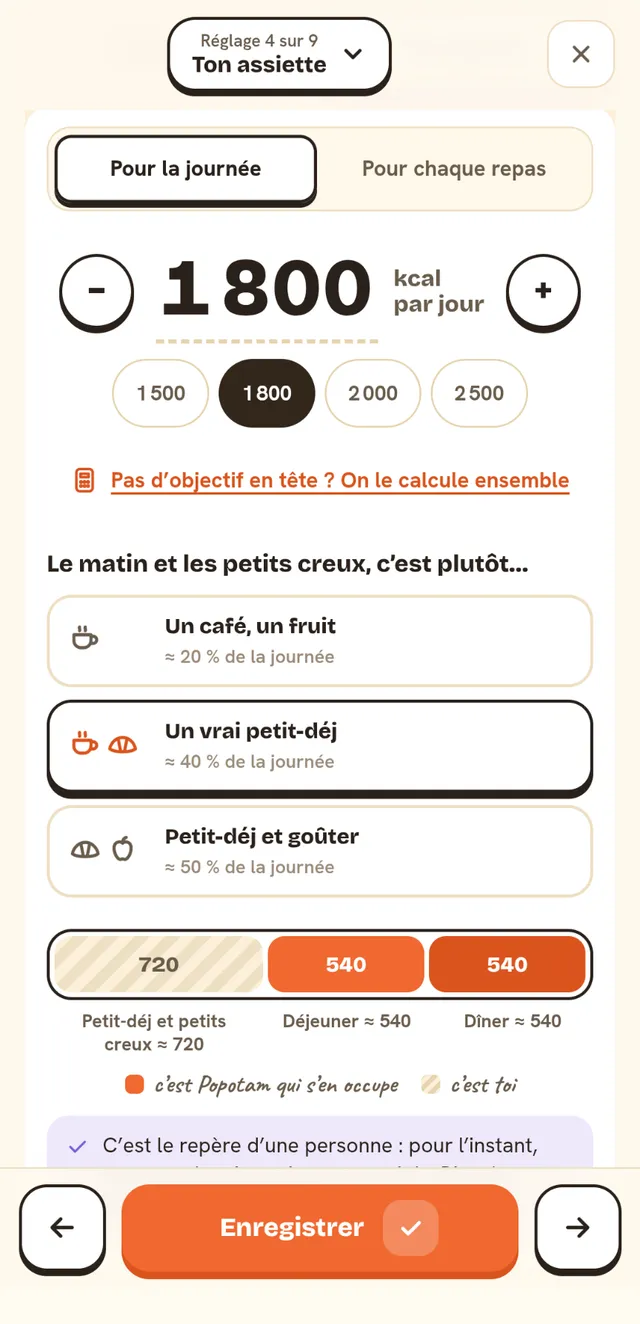
Choose “For the day” (the most common) or “For each meal” if your dietitian gave you one goal for lunch and one for dinner. Set it with − and +, with the keyboard, or with a shortcut: 1,500, 1,800, 2,000 or 2,500 kcal.
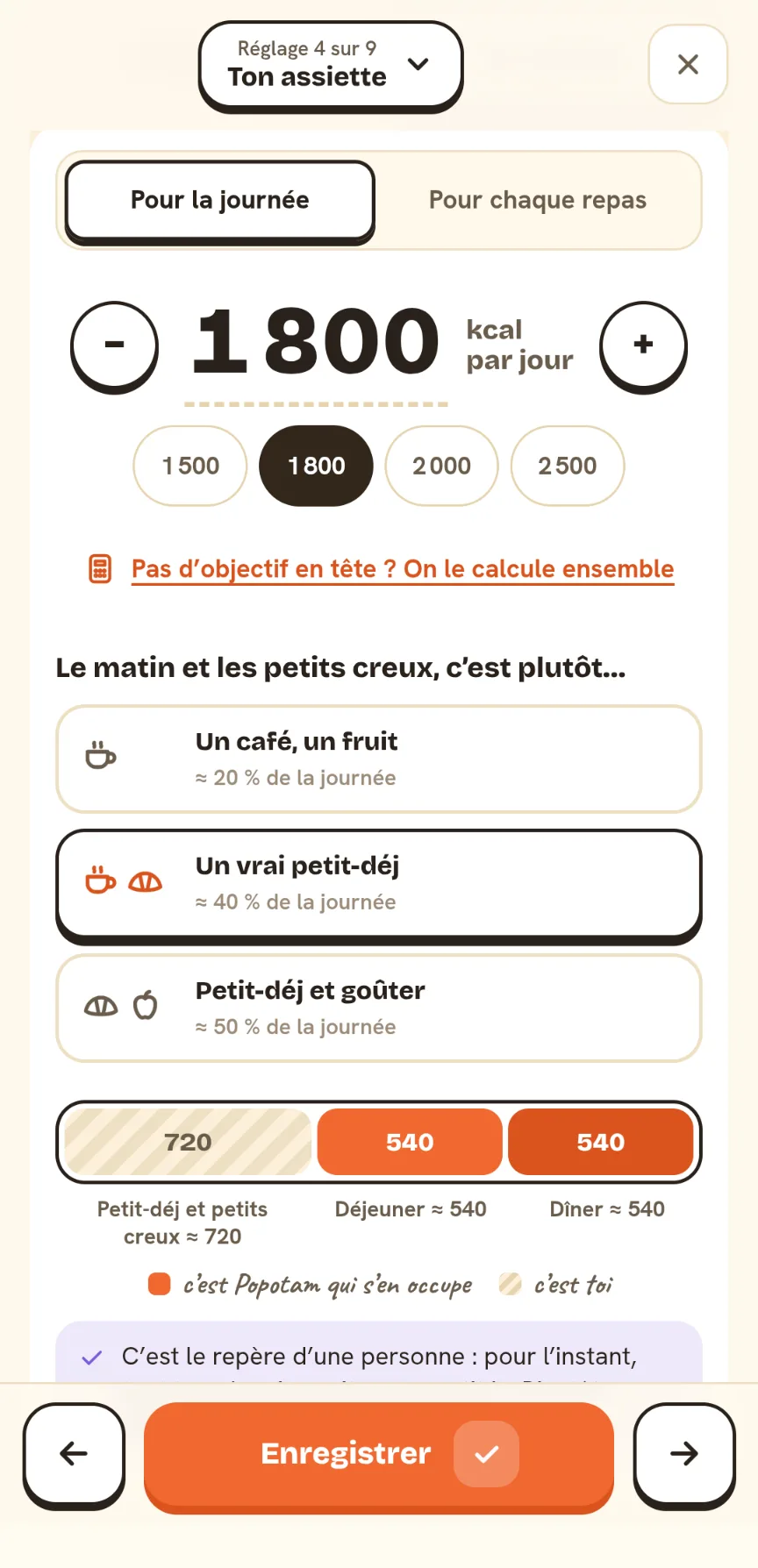
3. No goal in mind? Work it out
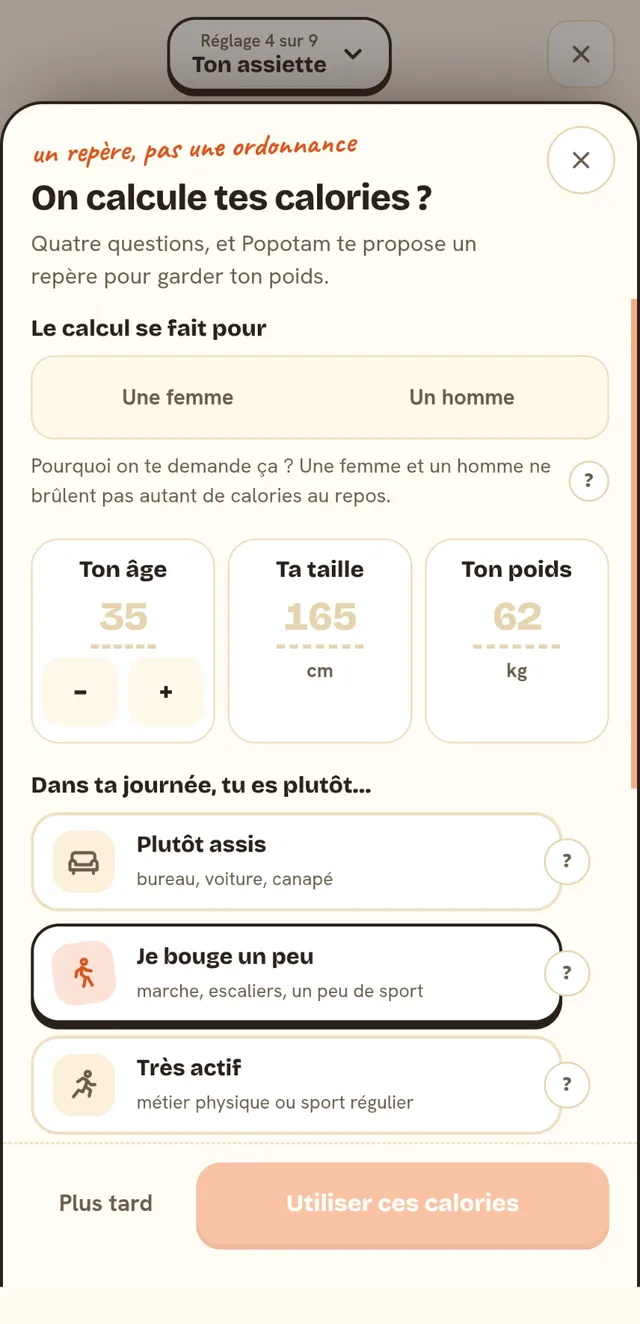
The “No goal in mind? Let's work it out together” link opens the quick calculator (detailed just below). “Use these calories” puts the result into your setting.
4. Say what you eat in the morning
Popotam plans lunch and dinner. Breakfast and snacks still count in your day: tell Popotam how big they are, and the day bar shows you what's left for your two meals.
5. Pick your dish style, and save
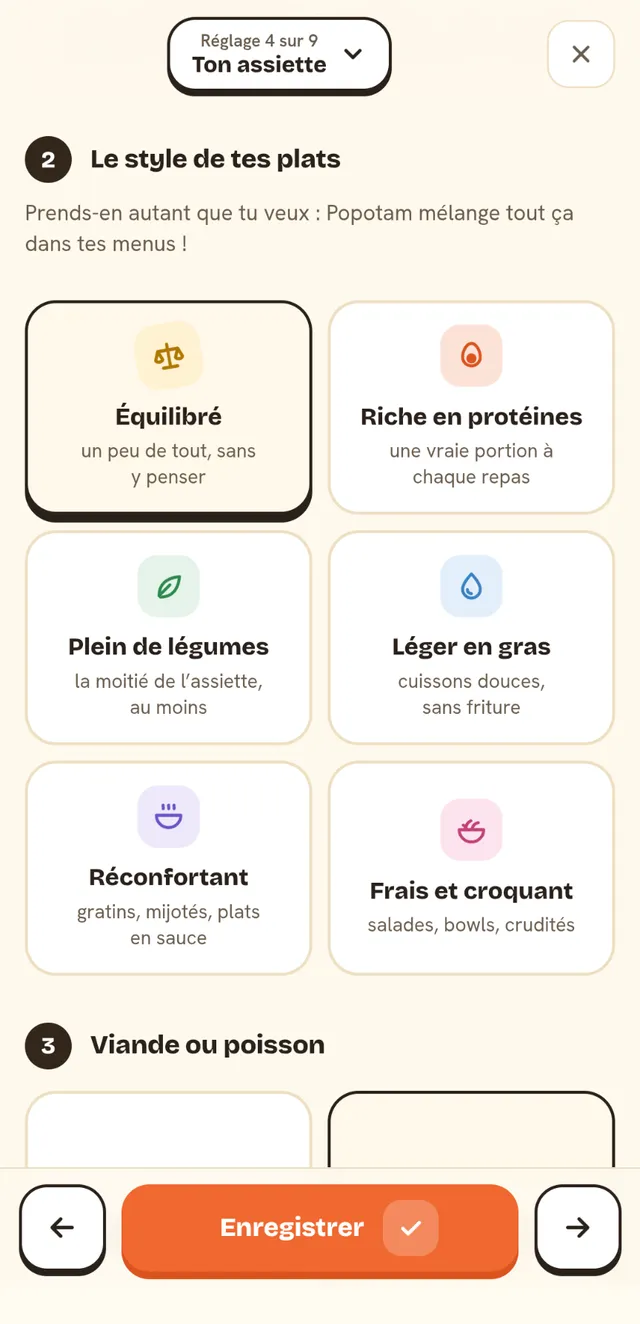
High protein, packed with veggies, low in fat, comforting, fresh and crunchy: pick as many as you like. “Save”, and Popotam adjusts the amounts in your upcoming meals.
Working out your calorie needs
Popotam uses the Black et al. (1996) equation, the one used by ANSES (the French food safety agency). It estimates what your body burns at rest from your sex, age, height and weight, then multiplies it by your activity level. The result is a target to maintain your weight, rounded to 10 kcal.
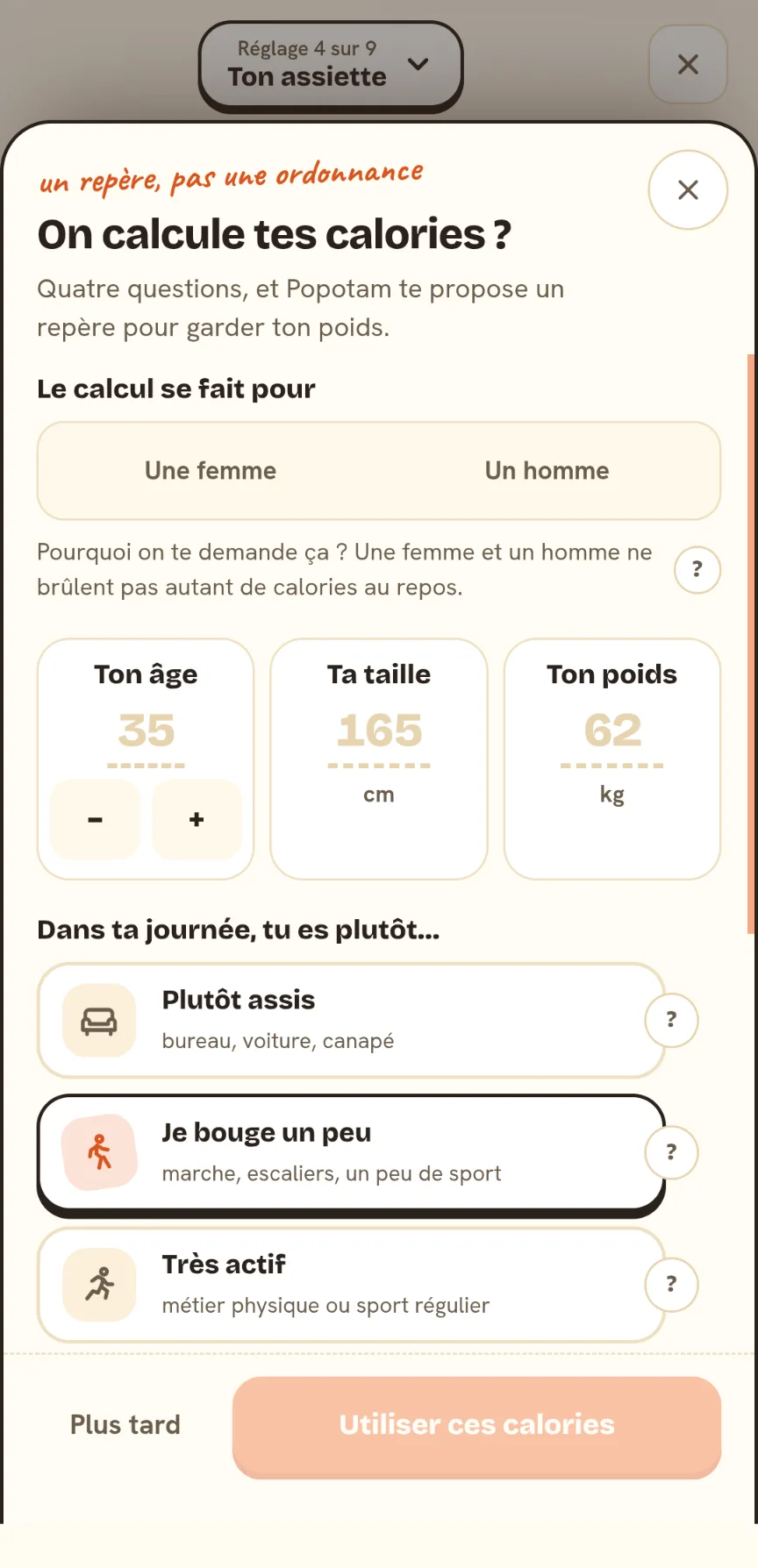
Why does Popotam ask whether you're a woman or a man? On average, men have more muscle, and muscle burns more at rest, so the calculation differs. This choice is only used for the calculation, and it isn't saved.
For your activity, a typical day is enough, no need to be exact:
How many calories per meal?
It all depends on what you eat outside lunch and dinner. With a real breakfast (about 40% of the day, snacks included), here's what's left for each of your two meals:
And depending on your morning, for a 1,800 kcal day:
With lighter evenings, lunch gets 10% more and dinner 10% less. And if your dietitian gave you a goal per meal, choose “For each meal”: Popotam aims for exactly your two numbers.
Your dishes, in the right amounts
Your dishes stay the same, Popotam simply adjusts the amounts. Here's how:
- Calories calculated, not guessed. Every ingredient is linked to its food in the ANSES Ciqual table, and the math uses the recipe's amounts. Never an AI.
- Your target from the start. When the AI plans your week, it gets your goal, per person, lunch and dinner. Then Popotam checks every dish and adjusts whatever is off.
- The dish keeps its proportions. Popotam scales the weighed ingredients up or down together, within a sensible range. And if you want protein, the meat, fish or legumes never shrink.
- Limits to keep it sensible. Pasta, rice and dried legumes have a per-person limit, sized to your plate, and never more than three eggs per person.
- All through your week. Meals planned by the AI and those from the catalog, without AI, plus the dishes you swap later. Your grocery list updates itself.
- Above, Popotam lets you know without holding you back. A 5,000 kcal day while training for a marathon? Popotam follows it, and tells you with a smile. It doesn't go below 1,200 kcal a day, or below 300 kcal per meal: below that, it's a health matter.
No number? Pick your appetite
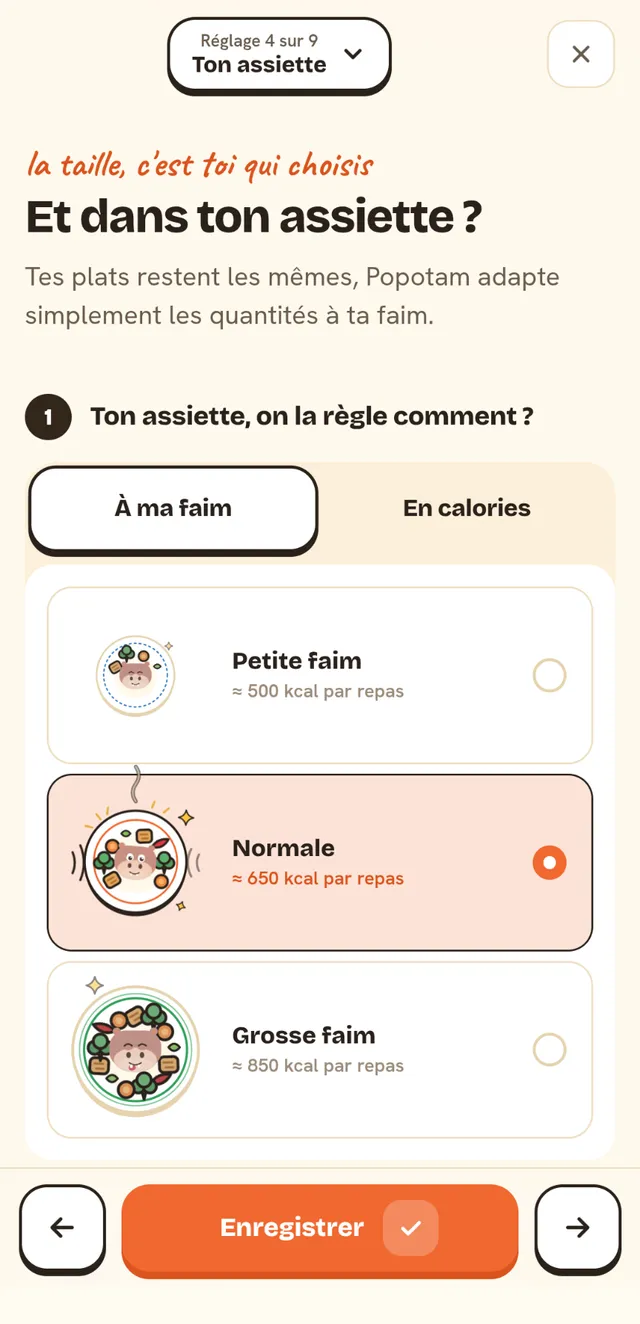
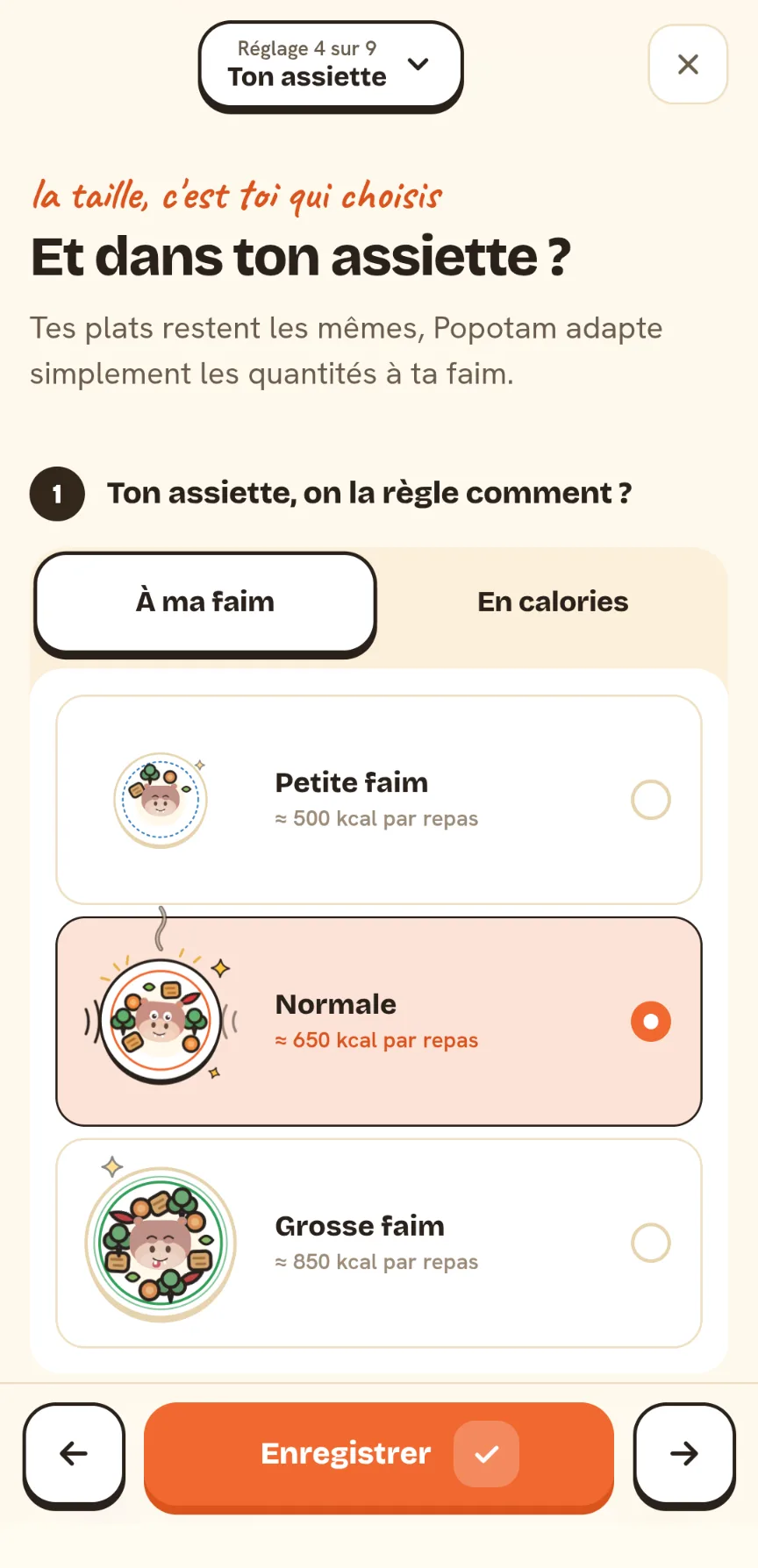
Not everyone wants to count, and that's totally fine. With “Simple: by appetite”, pick your plate size and Popotam takes care of the rest:
Your dish style, mix and match
- High protein: every meal aims for at least 30 g of protein per person (a little less for a small plate, up to 36 g for a big one), with a real serving of meat, fish, eggs, legumes or tofu. Popotam asks for it when planning, then checks it dish by dish.
- Packed with veggies: at least half the plate.
- Low in fat: gentle cooking, no frying and no heavy sauces.
- Comforting: bakes, stews, saucy dishes. Fresh and crunchy: salads, bowls, raw veggies.
Nothing checked means “Balanced”: a bit of everything, no fuss.
Your week in numbers
On the app's home screen, “Your week in numbers” shows each day's calories and the weekly average, lunch and dinner, per person, with your target next to them. You see at a glance whether your week is “right on target”. “Change my target” takes you back to the “Your plate” step.
Every dish also has its calories, protein, carbs and fat: the Calories and macros page has all the details.
What Popotam doesn't do
- It isn't medical advice. It's a guide for your meals. Pregnant or breastfeeding? Your needs change: ask your midwife or your doctor.
- It doesn't plan your breakfast or snacks. It keeps their share of the day and takes care of lunch and dinner.
- One target covers the whole meal plan, for now. With several people at the table, it's one person's target; soon, everyone will have their own.
- It only counts what it can measure. An ingredient missing from the Ciqual table isn't in the math: the dish stays, its calories are just less precise.
- It doesn't weigh you or track your weight. Popotam looks after what's on the plate, not the scale.
What stays on your device
- The calculation happens on your device. Your sex, age, height and weight are never sent or saved.
- Only your calorie goal is saved, with your meal plan, like the rest of your settings.
- No account: your meal plan lives behind its link, and anyone you share it with also sees your settings.
The details are in our privacy policy.
Why it's free
The calorie calculator is part of Popotam, free, with no account and no ads, which runs on donations from the people who use it. What Popotam spends is published on the transparency page, read straight from its accounts.
Frequently asked questions
With the Black et al. (1996) equation, the one used by ANSES (the French food safety agency): it starts from your sex, age, height and weight to estimate what your body burns at rest, then multiplies by your activity level (1.4 mostly sitting, 1.6 if you move a bit, 1.8 very active). In Popotam, it's the “No goal in mind? Let's work it out together” link: four questions, and the result is a target to maintain your weight, rounded to 10 kcal.
It depends on your day and your breakfast. For 1,800 kcal a day with a real breakfast (about 40% of the day with snacks), there's about 540 kcal left for lunch and 540 for dinner. Without a set goal, Popotam aims for about 500 kcal per meal for a small appetite, 650 for a regular one and 850 for a big one. These are guides for an adult.
Yes, with Popotam, free and with no account: in your settings, at the “Your plate” step, choose “Precise: in calories” and give your calorie goal, for the day or for each meal. Popotam plans your weekly meals as usual, then adjusts the amounts in every dish to hit your target, at lunch and at dinner. Your grocery list updates with the new amounts.
It's an estimate, not a measurement: the Black et al. equation gives an average for people like you, and your body may differ by a few hundred calories. It's a good starting point to maintain your weight. To lose or gain weight, or for a health goal, a dietitian will find the goal that suits you, and Popotam will handle the amounts.
From the ANSES Ciqual table, the French reference for food composition. Popotam links every ingredient of a dish to its Ciqual food and does the math with the recipe's amounts. Calories never come from an AI.
No: your dishes stay the same, Popotam simply adjusts the amounts. The dish's weighed ingredients scale up or down together to hit your target, with limits to keep it sensible (no more than three eggs per person, for example). It works for meals planned by the AI and for those from the catalog, without AI.
Two options. Simply pick your appetite (small, regular or big): that's the “Simple: by appetite” mode, and Popotam takes care of the rest. Or start the quick calculator, “No goal in mind? Let's work it out together”: four questions and a result you use in one go.
No. The calculation happens on your device: your age, height, weight and sex are never sent or saved. Only the calorie goal you choose is saved, with your meal plan.
Yes: Popotam doesn't go below 1,200 kcal a day, or below 300 kcal per meal, because below that it's about health, and a professional will guide you better. Above, nothing is blocked: a big 5,000 kcal training day, Popotam follows it and simply lets you know.
Yes: check “High protein” in your dish style. Every meal then aims for at least 30 g of protein per person (a little less for a small plate, up to 36 g for a big one), with a real serving of meat, fish, eggs, legumes or tofu: Popotam asks for it when planning, then makes it bigger if the count falls short. You can combine it with “Packed with veggies”, “Low in fat” or “Fresh and crunchy”.
Not as is. The quick calculator isn't made for under-18s, who are still growing, and pregnancy or breastfeeding change your needs: ask your midwife or your doctor. For now, one target covers the whole meal plan; soon, everyone at the table will have their own.
It's free, with no account, no subscription and no ads. The calorie calculator is part of Popotam like everything else. Popotam runs on donations from the people who use it, and its spending is public in full.